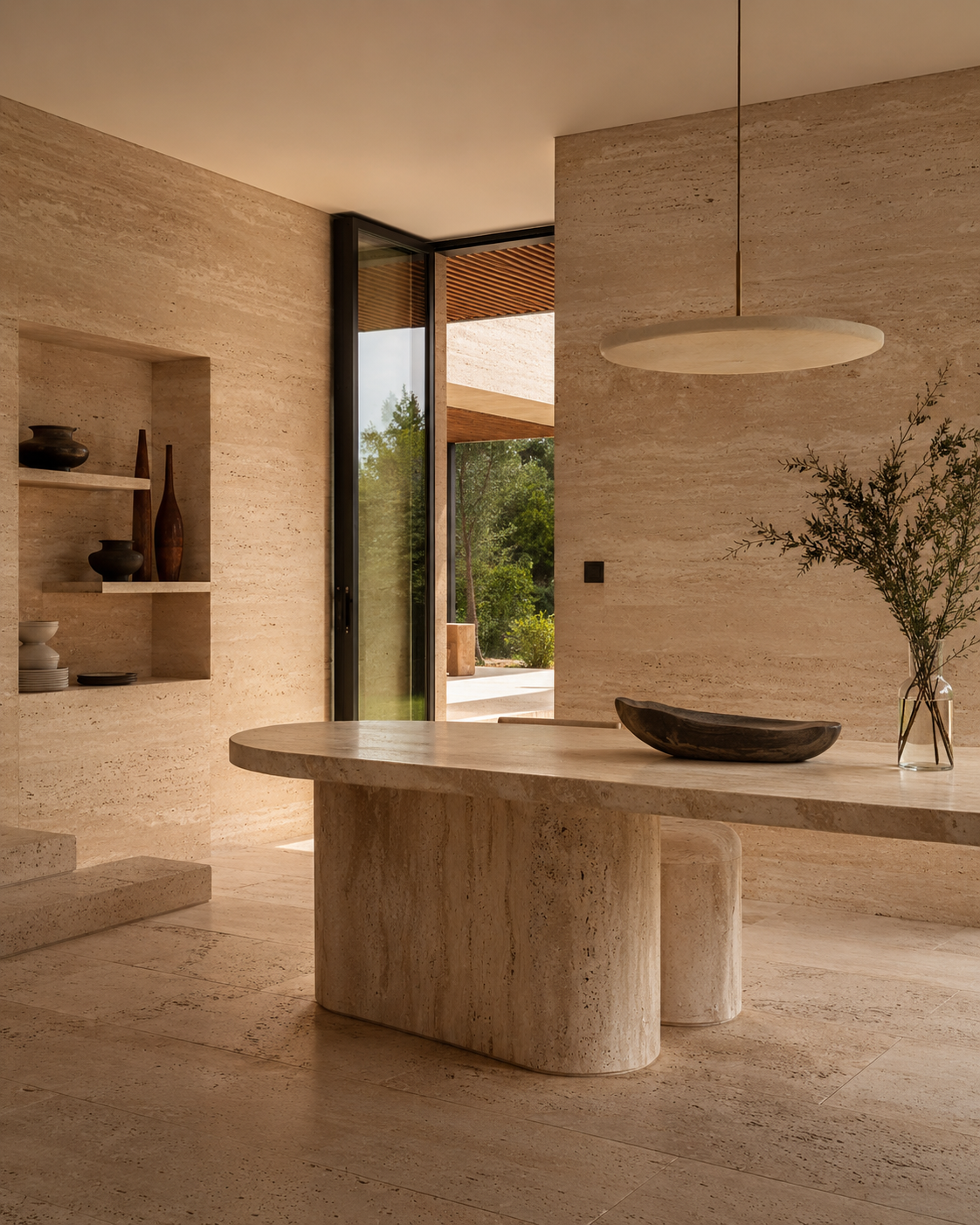

Travertine has never been merely a decorative fashion. From ancient Rome to the Barcelona Pavilion and contemporary interiors, the stone has remained part of architecture’s material language.
Travertine did not disappear after antiquity, and it was never confined to palaces or hotel lobbies. Its history is better understood as a long architectural continuum: a porous limestone formed by the precipitation of calcium carbonate from mineral-rich water, quarried around Tivoli east of Rome, and used repeatedly whenever designers wanted both durability and a visibly natural surface.
Roman builders used Tivoli travertine on an extraordinary scale. The stone became part of the physical identity of Rome through monuments including the Colosseum. It remained important in later periods as well: Renaissance and Baroque architecture continued the tradition, while modern architects adapted it to new structural systems and increasingly abstract compositions.
One of the clearest twentieth-century examples is the Barcelona Pavilion, designed by Ludwig Mies van der Rohe and Lilly Reich for the 1929 International Exposition. The Fundació Mies van der Rohe records Roman travertine among the four stones used in the pavilion. There, travertine was not treated as nostalgic ornament. Its broad horizontal planes helped define the floor, podium and spatial sequence, working alongside glass, steel, green marble and golden onyx. The project demonstrates that travertine already belonged to architectural modernism decades before the interiors associated with the 1980s.
The material’s character comes from its geological formation. Layers deposited by mineral water create pores, tonal variation and directional patterning. How a block is cut changes what becomes visible. A vein cut follows the stone’s stratification and produces linear bands; a cross cut moves across those layers and reveals a softer, more cloud-like field. Filling, honing or brushing the surface further changes how strongly its pores register and how it reflects light.
That range explains travertine’s continuing relevance. It can be used as exterior cladding, paving, flooring, stairs and wall surfaces, but also for basins, tables and other custom elements. Contemporary fabrication makes it possible to produce precise junctions and substantial sculptural forms, yet the material still carries natural variation from one block to another. Responsible specification therefore begins with the actual slab or block, the intended environment and the required finish—not simply with a colour selected from a photograph.
Calling the present moment a “return” is useful only as a description of renewed design attention, not as a claim that travertine vanished. Research into its use in Italian architecture documents continuity across historical periods, including twentieth-century civic construction. What has changed is the contemporary emphasis: designers increasingly foreground the stone’s mass, pores and layered grain rather than treating it merely as a polished sign of luxury.
Travertine’s appeal rests on this productive tension. It can feel ancient without requiring a historical interior, and monumental without becoming visually heavy. Its warm neutral tones sit quietly in a room, while its geological structure prevents the surface from becoming anonymous. Used carefully—and described accurately—it connects contemporary design with a building tradition that has developed over more than two millennia.
Sources consulted
Fundació Mies van der Rohe — The Pavilion: https://miesbcn.com/the-pavilion/
Rescic et al., Historical Use of Travertine in Tuscan Architecture, Minerals 14(3), 2024: https://www.mdpi.com/2075-163X/14/3/280
Travertino Romano — Authentic Roman Travertine from Italy: https://www.travertino-romano.com/en
Sources & verification
Verified by RACONIA Editorial on 14 September 2026.
- The Pavilion — materials and history — Fundació Mies van der Rohe
- Historical Use of Travertine in Tuscan Architecture (Italy) — Minerals, MDPI
- Authentic Roman Travertine from Italy — Travertino Romano